EMIS Core Triangle
EMIS — Energy · Matter · Information · Spacetime
A conceptual framework for explaining how the world works.
1. Positioning
EMIS is not a new set of physical laws.
It is an explanatory framework.
Rather than asking what the world is made of, EMIS focuses on a more fundamental question:
How does change occur?
Under what constraints does change take place?
How is change distributed and shaped across Energy, Matter, Information, and Spacetime?
EMIS provides a unified perspective for analyzing physical, computational, biological, and social systems by modeling their core structural relationships.
2. Core Elements
-
Energy
The universal measure and regulatory variable of change. -
Matter
The physical substrate that allows change to become stable and persistent. -
Information
The description of system states and their distinguishable structures. -
Spacetime
The structural and causal constraints within which change unfolds.
3. The Six Core Relationships
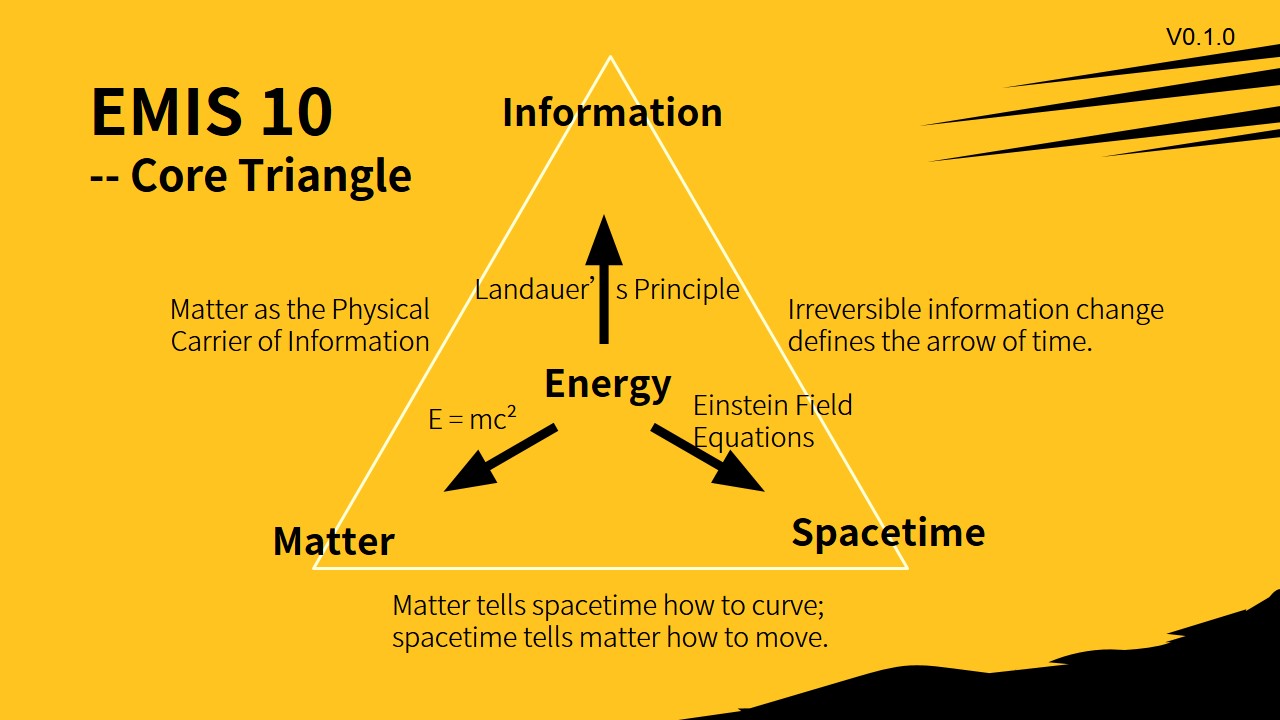
EMIS is structured around an energy-centered triangle, expanded into six fundamental relationships.
3.1 Energy — Matter
(Mass–Energy Equivalence)
Matter does not exist independently of energy.
Matter is the stabilized manifestation of energy under physical constraints.
Mass–energy equivalence reveals that mass is not a separate substance, but a form of energy localized and conserved under specific conditions. Energy determines which material structures can exist, how stable they are, and how they can transform.
Reference:
Mass–Energy Equivalence (E = mc²)
Core Claim:
Energy determines the existence and stability of matter.
3.2 Energy — Information
(Landauer’s Principle)
Information is not an abstract entity; it is a physical quantity constrained by energy.
Any creation, transformation, or erasure of information requires an irreducible amount of energy. Thermodynamic limits define the minimum energetic cost of information processing, while entropy characterizes how information is distributed across physical state spaces.
Reference:
Landauer’s Principle
Core Claim:
Energy determines the cost and feasibility of information change.
3.3 Energy — Spacetime
(Energy–Momentum Constrains Geometry)
Spacetime is not an independent stage.
Its geometry is constrained by the distribution of energy and momentum.
At the same time, spacetime geometry constrains how energy propagates, accumulates, and interacts. Energy and spacetime are therefore mutually coupled through physical law.
Reference:
Energy–momentum constrains spacetime geometry
(Einstein Field Equations)
Core Claim:
Energy distribution constrains the form and variability of spacetime.
3.4 Matter — Information
(Matter as the Physical Carrier of Information)
Matter is not information itself; matter provides the physical state space in which information exists.
Information emerges as structured patterns of distinguishable states supported by material systems. Different material substrates define different state spaces, thereby determining the form, capacity, and stability limits of information.
Core Claim:
Matter determines the capacity and structure of information.
3.5 Matter — Spacetime
(Core Statement of General Relativity)
Matter and spacetime are not separable entities; they mutually shape one another.
The distribution of matter influences how spacetime curves, while spacetime geometry constrains how matter moves and remains stable.
Reference:
Matter tells spacetime how to curve;
spacetime tells matter how to move.
Core Claim:
Matter and spacetime jointly define realizable structures.
3.6 Information — Spacetime
(Irreversibility and the Arrow of Time)
Information change is irreversible at macroscopic scales.
The accumulation of irreversible information transformations manifests as temporal directionality, establishing a distinction between past and future and giving rise to causal order.
Reference:
Irreversible information change defines the arrow of time.
Core Claim:
The direction of time emerges from irreversible information change.
4. Unified Statement
Energy regulates change.
Matter stabilizes structure.
Information describes state.
Spacetime provides constraint.
In EMIS, none of these elements are reduced to another.
Instead, they form a minimal closed system for explaining how systems operate and evolve.
5. Framework Statement
EMIS is an energy-centered explanatory framework
for understanding how change is constrained, distributed, and evolved
across Matter, Information, and Spacetime.
6. Scope of Application
At its current stage, EMIS Framework is primarily applied to selected domains within the social sciences, where energetic constraints, structural costs, and information flows are explicitly observable, including:
- Economics
- Sociology
- Political Economy and Institutional Analysis
These domains serve as the initial testing ground for the framework before potential extension to other disciplinary systems.
EMIS Framework does not claim that matter, information, or spacetime are ontologically reducible to energy. Energy is treated as a governing and accounting variable that constrains transformation and evolution, not as the sole substance of reality.
7. Status
This framework is conceptual and interpretive in nature.
It does not propose new physical laws, but provides a unified structure for understanding how existing laws interact across domains.
8. License
MIT