EMIS Framework
A Unified Energy-Based Framework for Understanding Social Systems
(Experimental v0.1.1)



“In the evolution of systems,
all change is constrained by energy.”
0. Developer’s Note
EMIS is an experimental analytical framework.
It does not claim to provide ultimate truths, normative prescriptions, or closed-form answers about human civilization.
Instead, EMIS proposes a first-principles observational perspective:
to examine social, economic, and political systems under a unified set of physical and energetic constraints.
We fully acknowledge that this framework is incomplete and subject to revision.
Contributions, critiques, and formal objections are not only welcome, but necessary for its evolution.
1. The Problem
Modern civilization faces a paradox:
- Unprecedented data availability and computational power
- Increasing fragmentation of knowledge across disciplines
Economics, sociology, political science, and related fields often operate in parallel, with incompatible primitives and limited interoperability.
What is missing is a shared low-level analytical interface—
a variable that is both physically grounded and socially operative.
2. Core Hypothesis
EMIS advances the following hypothesis:
The evolution of social systems is driven by the optimization of energy capture, allocation, and utilization under physical, informational, and institutional constraints.
This hypothesis is descriptive, not normative.
It explains how systems evolve, not how they should evolve.
3. Core Architecture
To operationalize this hypothesis, EMIS adopts a unified structural lens:
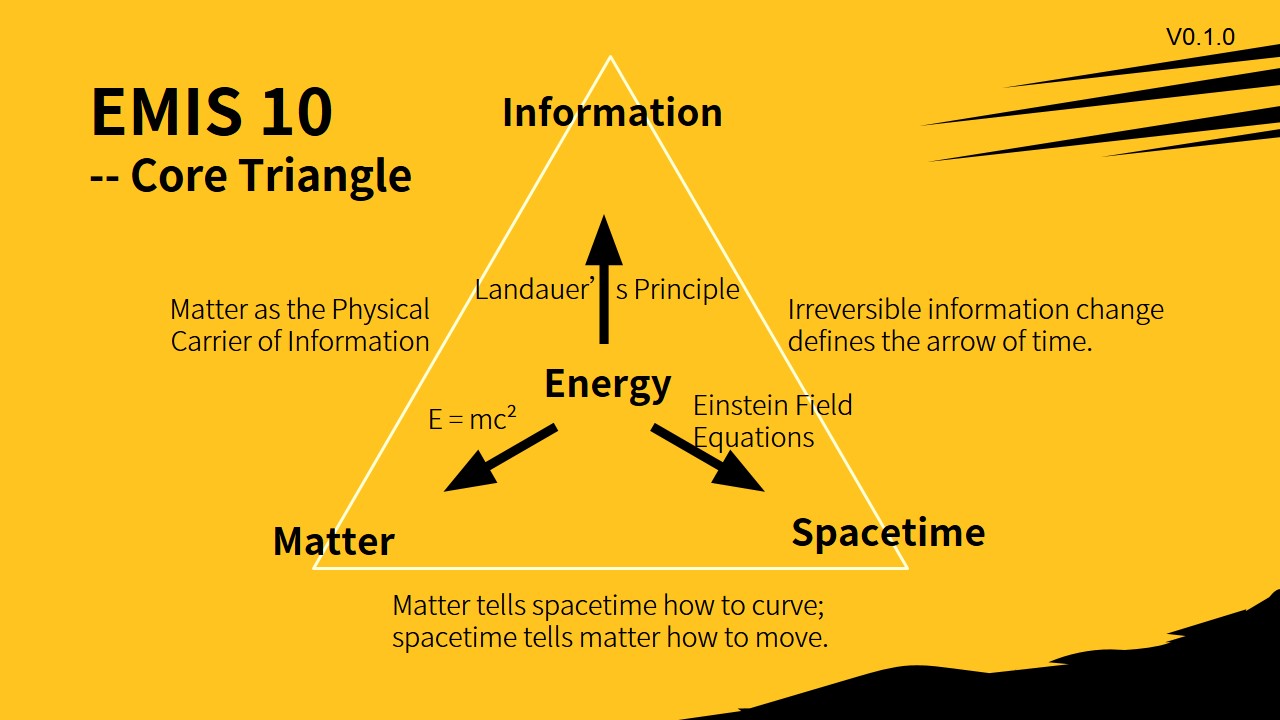
- Energy — the fundamental driver and limiting variable of change
- Matter — the physical substrate that stores and transmits energy
- Information — the structural and rule-based organization of states
- Spacetime — the boundary conditions under which all processes occur
Together, these four dimensions define the constraint space within which all social systems operate.
4. Scope and Objectives
EMIS does not replace existing disciplines.
Its objective is to establish structural equivalence across them.
Specifically, EMIS aims to:
- Provide a common analytical substrate shared by economics, sociology, and political science
- Reinterpret core social concepts (e.g., money, power, institutions) as energy-constrained structures
- Reduce explanatory redundancy by identifying invariant patterns across scales
The framework is intentionally minimal, extensible, and open-ended.
5. Computational Application: Neuro-symbolic AI
Beyond its theoretical utility, EMIS is designed as a Neuro-symbolic Constraint Layer for Artificial Intelligence, specifically Large Language Models (LLMs).
Current LLMs operate probabilistically, often generating plausible but logically inconsistent narratives when reasoning about complex social dynamics (Hallucination).
EMIS addresses this by providing a ground-truth symbolic structure:
- Constraint Enforcement: EMIS functions as a “Physics Engine” for social reasoning. It rejects generated outputs that violate fundamental energy-information constraints (e.g., infinite growth without entropy production).
- Logical Grounding: By mapping vague natural language concepts (e.g., “Revolution”) to precise state-space transitions (e.g., “Structural rupture due to energy gradient”), EMIS enables AI to reason with causal fidelity.
- Token Efficiency: Complex socio-historical contexts can be compressed into low-dimensional EMIS vectors, serving as an efficient Intermediate Representation (IR) for long-horizon reasoning.
We invite AI researchers to utilize EMIS as a structural prior or reward model component to enhance the reasoning capabilities of models in economics, strategy, and policy domains.
6. Repository Structure
/
├── _config.yml         # Site configuration
├── README.md           # English Introduction
├── README_zh.md        # Chinese Introduction
├── assets/             # Images and Styles
│   └── images/
└── _emis/              # Documentation Source
    ├── en/             # English Docs
    │   ├── 00-introduction/
    │   ├── 01-axioms/
    │   └── 10-core-triangle/
    │   └── .../
    └── zh/             # Chinese Docs
7. Citation & Attribution
If you reference or build upon this work, please cite:
EMIS Framework v0.1.1
Zenodo. https://doi.org/10.5281/zenodo.18287640
This repository is released under the MIT License and is intended for open academic use. Attribution preserves conceptual clarity and scholarly continuity.
8. How to Contribute
- Submit an Issue: If you find logical loopholes or inconsistencies.
- Pull Request: If you want to contribute a more precise definition for a specific discipline.
- Discussions: If you want to explore implications, limitations, and extensions
EMIS is not finished. It is a hypothesis under construction.